Neuroscience
The Buzz Around Psychedelics: Is the Hype Real?
· 13 min read
Psychedelics went from banned to a White House priority in a few years. I dug into what they do in the brain, what the trials actually show, what users report, and who stands to make money, to answer one question: is the hype real?
A few years ago, psilocybin was a Schedule I drug with "no accepted medical use." This year the President signed an executive order to speed up psychedelic drug reviews, the FDA handed out priority vouchers to two psilocybin developers, and the Health Secretary promised psychedelic therapy within a year. Around 11 million American adults used psilocybin in the past year. Investors are back, and the first approval of a classic psychedelic could come in 2027.
Then this month, five labs at UCSF, Berkeley, Stanford and elsewhere published the results of running the same mouse experiment side by side, and most of psilocybin's famous lasting effects didn't show up.
I wanted to know whether the hype is real, so I went through the history, the brain science, the human trials, what people who use these drugs report, and the money.
An old drug with a short research history
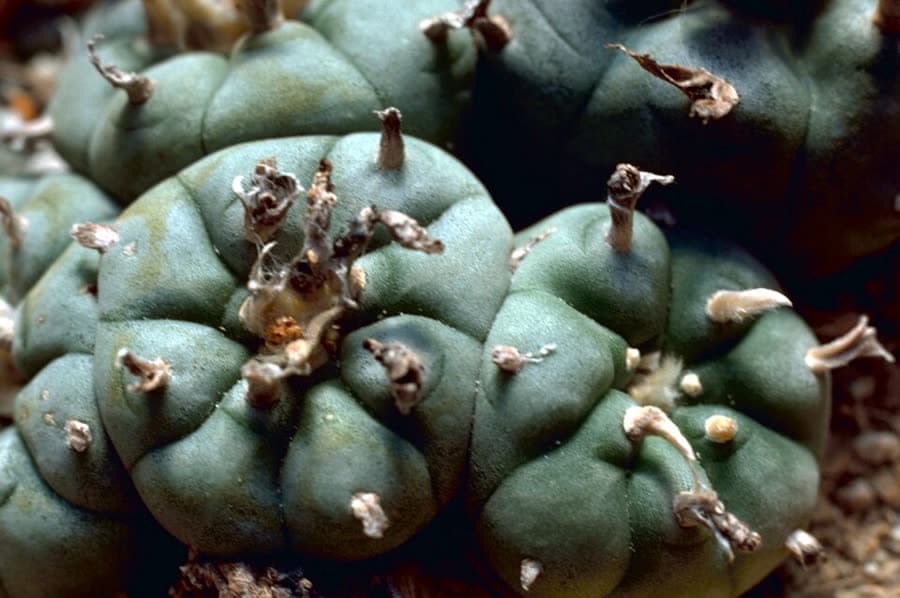
People have been using psychedelics for thousands of years. Peyote buttons found in a Texas cave and carbon-dated to about 5,700 years ago still contain mescaline. Spanish accounts from the 1500s describe the Aztecs eating teonanácatl, "divine mushrooms," at ceremonies, and Mixtec and Aztec codices draw them. Other claims are shakier, such as the fun but unproven idea that the ancient Greeks drank an LSD-like ergot brew at Eleusis.

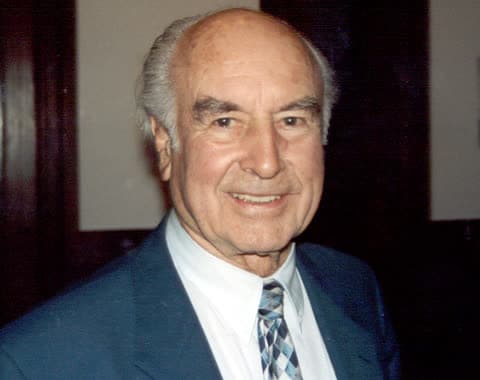
The modern story starts in Switzerland, where Albert Hofmann, a chemist at Sandoz, synthesized LSD in 1938 and discovered its effects by accident in 1943. In 1958 he isolated psilocybin from Mexican mushrooms. Sandoz shipped LSD to researchers around the world, and by the mid-1960s there were more than 1,000 clinical papers covering roughly 40,000 patients, on alcoholism, depression and the anxiety of dying.
That research came to a halt as LSD spread into the counterculture. California banned it in 1966, and the 1970 Controlled Substances Act put psychedelics in Schedule I. A UN treaty spread the ban worldwide a year later. Human research nearly vanished for about 30 years, until Johns Hopkins won approval to give psilocybin to healthy volunteers in 2000.
What psychedelics actually do in the brain
This is the part I find most interesting, and it explains both the excitement and the caution.
The whole process starts with one receptor for serotonin, a chemical messenger made by a small cluster of brainstem neurons called the raphe nuclei, whose projections reach almost the entire brain. Serotonin has roughly 14 receptor types, and the classic psychedelics, including psilocybin, LSD, DMT and mescaline, all switch on the same one, called 5-HT2A. Psilocybin is really a delivery vehicle that the liver turns into psilocin, a molecule that looks almost exactly like serotonin. The clearest evidence that 5-HT2A matters comes from ketanserin, a drug that blocks the receptor and makes the trip almost disappear.
Where 5-HT2A receptors sit in the brain goes a long way toward explaining what the experience feels like. They are densest on large neurons in the prefrontal cortex, the area that handles planning and your sense of self. The visual cortex is also packed with them, which helps explain why visuals are so prominent, and so is a set of regions called the default mode network. That network is active when your mind wanders and ruminates, and it's often overactive in depression.
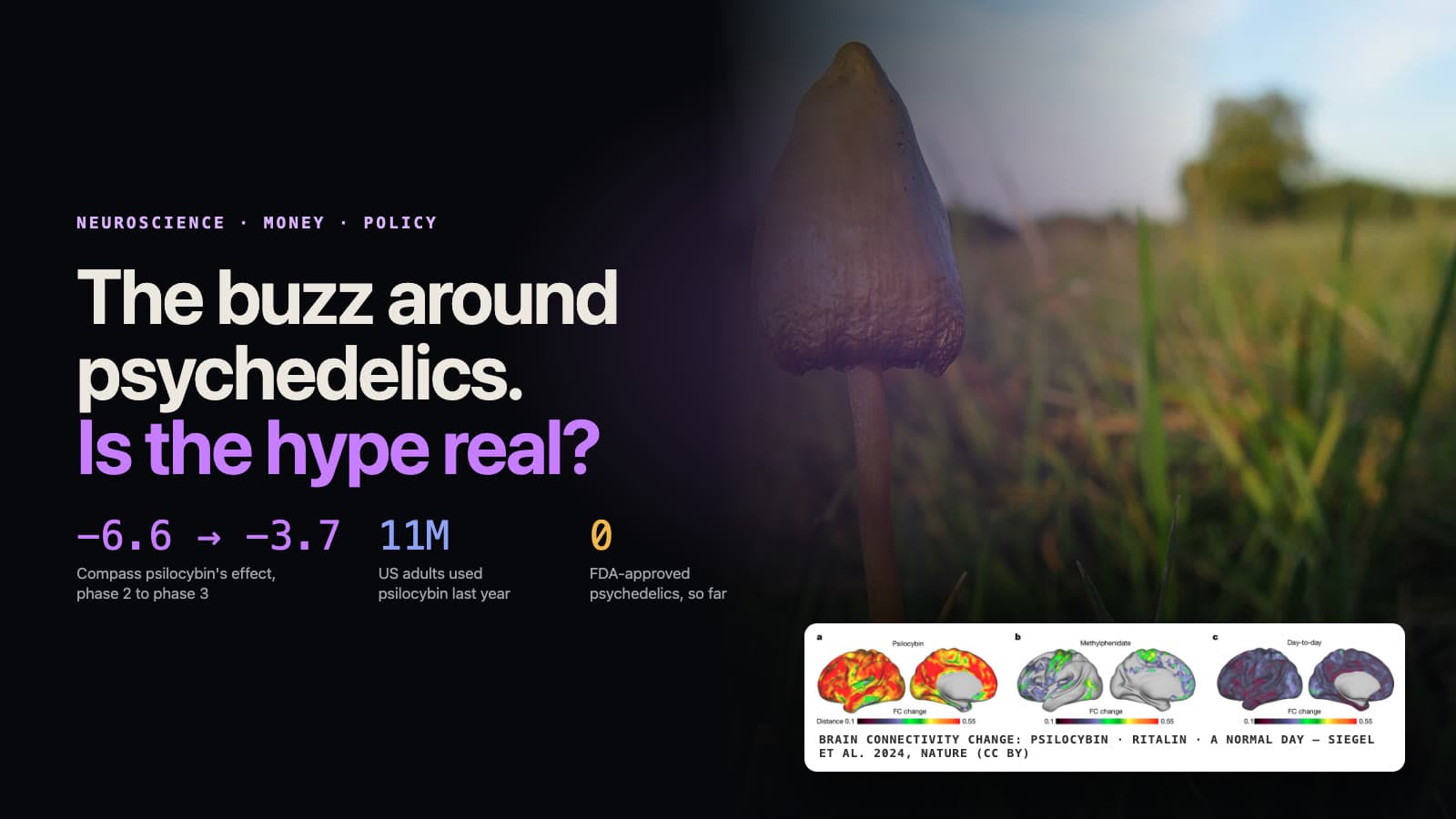
At the level of whole networks, the brain becomes less rigid on these drugs. In a 2024 Nature study, Joshua Siegel and colleagues scanned the same people again and again. Psilocybin changed how brain regions communicate more than three times as much as Ritalin did, and the default mode network changed the most. One link, between the hippocampus and that network, stayed weaker for about three weeks. The leading theory is that psychedelics temporarily loosen the brain's most entrenched patterns of thought, which might make them easier to change in therapy.
The real data: psilocybin vs a stimulant vs a normal day

Warmer colors mean bigger changes in how brain regions talk to each other. Left: psilocybin (25 mg). Middle: methylphenidate (Ritalin), the active control. Right: ordinary day-to-day variation in the same people.
Down at the level of individual cells, what happens looks a lot like rewiring. Turning on 5-HT2A boosts glutamate, the brain's main "go" signal, and that triggers a growth factor called BDNF and the growth of new dendritic spines, the contact points between neurons. In mice, one dose of psilocybin added about 10% more spines in the frontal cortex within a day, and they were still there a month later. Researchers call these drugs "psychoplastogens," and a 2023 study found LSD and psilocin also bind BDNF's receptor directly, far more tightly than Prozac. That finding feeds the field's biggest debate, over whether the trip itself is necessary or just a side effect.
Outside the brain, about 90 to 95% of the body's serotonin is in the gut, which is why mushrooms often cause nausea. Psilocybin itself is not very toxic. The open safety question involves a cousin receptor, 5-HT2B, found on heart valves. The diet drug fen-phen damaged valves through it, and psilocin and LSD activate it too. That doesn't matter much for a few doses, but it's a real question for people who microdose for months.
You can explore all of this yourself in the interactive figure below.
A contradictory mouse study
Much of the excitement rests on animal studies like that spine-growth result, and on a 2023 Nature paper from Gül Dölen's lab, then at Johns Hopkins and now at Berkeley, showing psychedelics reopen a "critical period" in mice, a window when the brain can relearn social reward, like it did in childhood.
This month, a group of labs at UCSF, UC Berkeley, Stanford and elsewhere published something unusual in Nature Neuroscience. Instead of one lab running one experiment, five labs ran the identical psilocybin protocol in about 200 mice per test. Right after dosing, every lab saw the same pattern, with mice showing more anxiety and less fear. But a day later, the antidepressant-like effects mostly weren't there; only two of five labs saw one, in one of two tests, and the pooled result was null. Fear extinction didn't improve, and the social-reward window didn't reopen either.
The authors are careful to say this is not evidence psilocybin fails in humans. Mice are not people, and a drug that changes how you understand your own life may not have a clean mouse equivalent. But it's a warning that some of the most-cited mechanisms behind the hype are less solid than they looked.
What the human trials show
The human evidence is real, though the effects are smaller than the early headlines suggested. The most advanced program is Compass Pathways' COMP360, a synthetic psilocybin for treatment-resistant depression, meaning patients who haven't been helped by at least two antidepressants. In its 2022 phase 2 trial, one 25 mg dose cut depression scores 6.6 points more than a tiny 1 mg dose on a 60-point scale. In its two large phase 3 trials, the advantage was 3.6 and 3.8 points. That's still a win, and it's about the same as esketamine (Spravato), the nasal spray already approved for the same patients.
Usona Institute's phase 2 trial in general depression looked much bigger, about 12 points, and LSD from Definium (formerly MindMed) posted strong phase 3 results in depression and anxiety this year. Smaller phase 2 trials tend to shrink in phase 3, though, as Compass's did.
Beyond depression, the signals are promising but early. In alcohol use disorder, people given psilocybin had heavy-drinking days 9.7% of the time versus 23.6% on placebo. In two 2016 studies of cancer patients, single doses eased anxiety and depression for months. A pilot study for smoking reported 80% abstinence at six months, but it had only 15 people and no control group. MDMA for PTSD won two phase 3 trials, yet the FDA rejected it in 2024, citing trial design and data problems.
MDMA for PTSD: the second phase 3 trial
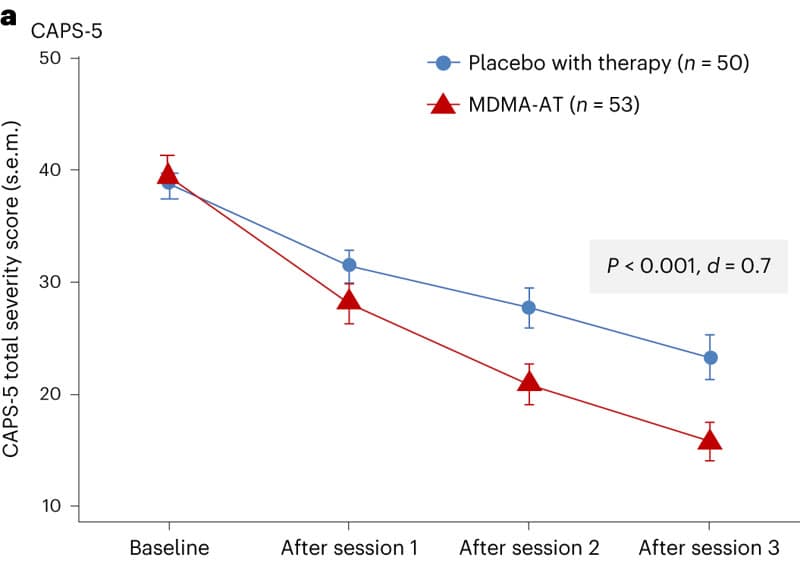
The trials also have a deep methodological problem. About 90 to 95% of people in psychedelic trials can tell whether they got the real drug, compared with about 60% in antidepressant trials. That makes a true placebo almost impossible and lets expectations inflate results. A March 2026 JAMA Psychiatry analysis compared psychedelic trials with antidepressant trials where patients also knew what they were taking, and found psychedelic therapy no more effective.
What people who use them say
Clinical trials are only half the story. Millions of people take psychedelics outside the lab, and past-year use among Americans aged 35 to 50 went from about 0.5% in 2012 to around 4% in 2022 and 2023.
What they report is genuinely mixed. Published studies of Reddit communities and online surveys keep finding the same themes: perspective shifts, better mood, insight and connection, but also panic, paranoia, lasting visual aftereffects and plenty of "nothing happened." In one survey of nearly 2,000 people describing their worst psilocybin trip, 11% called it the single most difficult experience of their lives, and yet 84% said they benefited from it.
Microdosing, taking tiny doses every few days, is the most popular and least supported use. A 2025 RAND survey suggests most past-year psilocybin users have tried it. In controlled studies it mostly looks like placebo, and one LSD microdosing program reported a 60% drop in depression symptoms without a placebo group, then failed every endpoint when it added one.
On safety, mushrooms rank among the least harmful drugs. In a large international survey, 0.2% of users needed emergency care in a year, lower than for alcohol or cannabis, and an expert panel in The Lancet rated them the least harmful of 20 drugs. But low average harm isn't zero harm, especially for people with a personal or family history of psychosis.
My take
When I got to Berkeley, I was wary of psychedelics, even a little afraid of them. That changed as they kept coming up in my coursework and in my neuroscience lab, where psilocybin, LSD and DMT are widely studied. Today I lean positive on both their medical and recreational use, as long as people are responsible about it. What won me over was the research on psychedelics as a therapy, and the study that stuck with me most was a small Johns Hopkins trial of 27 adults with long-standing depression. After two doses of psilocybin alongside psychotherapy, their average depression score fell from 22.8 to 8.7 one week after treatment and was still 7.7 a year later. At that 12-month mark, 75% of the 24 people who completed every follow-up were still responding to treatment and 58% were in full remission, meaning their symptoms had essentially disappeared.
The way I picture what's happening is a landscape. In depression, thinking settles into a few deep wells, and it becomes hard to climb out of the same patterns. For a while, psilocybin seems to flatten that landscape. That fits the network studies above and the way people describe having their usual thinking "shaken up." After treatment the wells are shallower, and moving between different thoughts and perspectives gets easier. The biology also involves more than one receptor. A 2025 study I read in Nature Communications found that serotonin and psilocybin also act on a second serotonin receptor, 5-HT1B, to dampen cortical signaling that runs through the claustrum, a thin sheet of neurons that helps coordinate the cortex.
How psilocybin may loosen depressive thinking
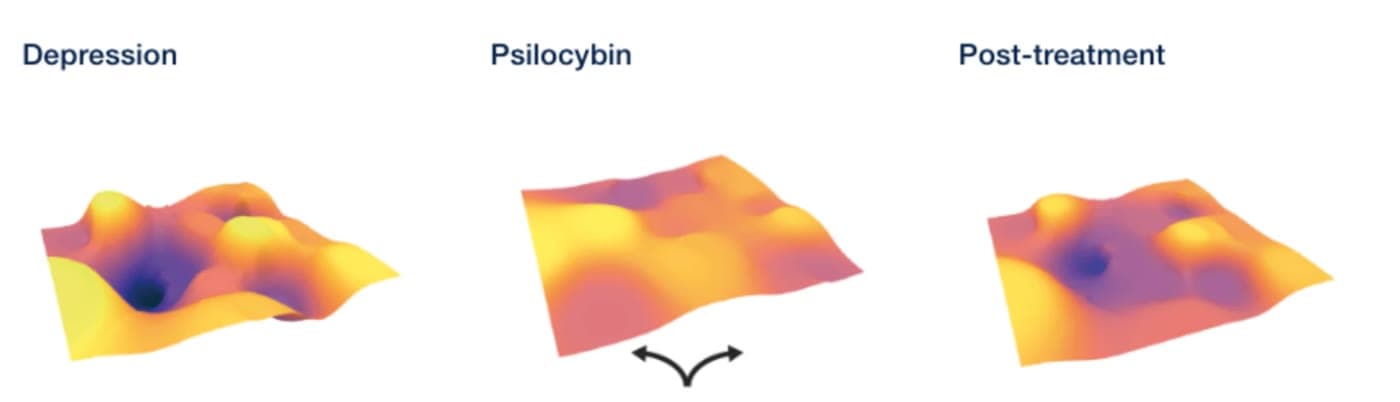
Depression. Rigid thought patterns form deep wells that are hard to move between.
Psilocybin. Therapy temporarily flattens the landscape, letting new thoughts and perspectives emerge.
After treatment. Shallower wells make it easier to shift between different patterns of thinking.
The skeptical evidence in this piece doesn't change my overall view. Effects in the large trials are smaller than in the early ones, the blinding problem is real, and some of the animal findings didn't replicate. I'm still excited to see where the research goes, and the Hopkins study is only one example; work on PTSD, anxiety and neuroplasticity more broadly looks promising too. On the recreational side, the safety data are reassuring for most people, but being responsible still matters a great deal, especially for anyone with a personal or family history of psychosis.
Berkeley is a good place to watch the field mature. Michael Pollan, Dacher Keltner and David Presti founded the Center for the Science of Psychedelics here in 2020, and it now runs its own FDA-regulated studies. One looks at how psilocybin changes visual perception and attention, and another tests whether it can promote plasticity in adults aged 60 to 85. Gül Dölen's lab is testing whether psychedelics, paired with a motion-capture game where patients steer a virtual dolphin, can help stroke survivors recover movement. Berkeley researchers were also among the authors of the five-lab mouse study that tempered the hype.
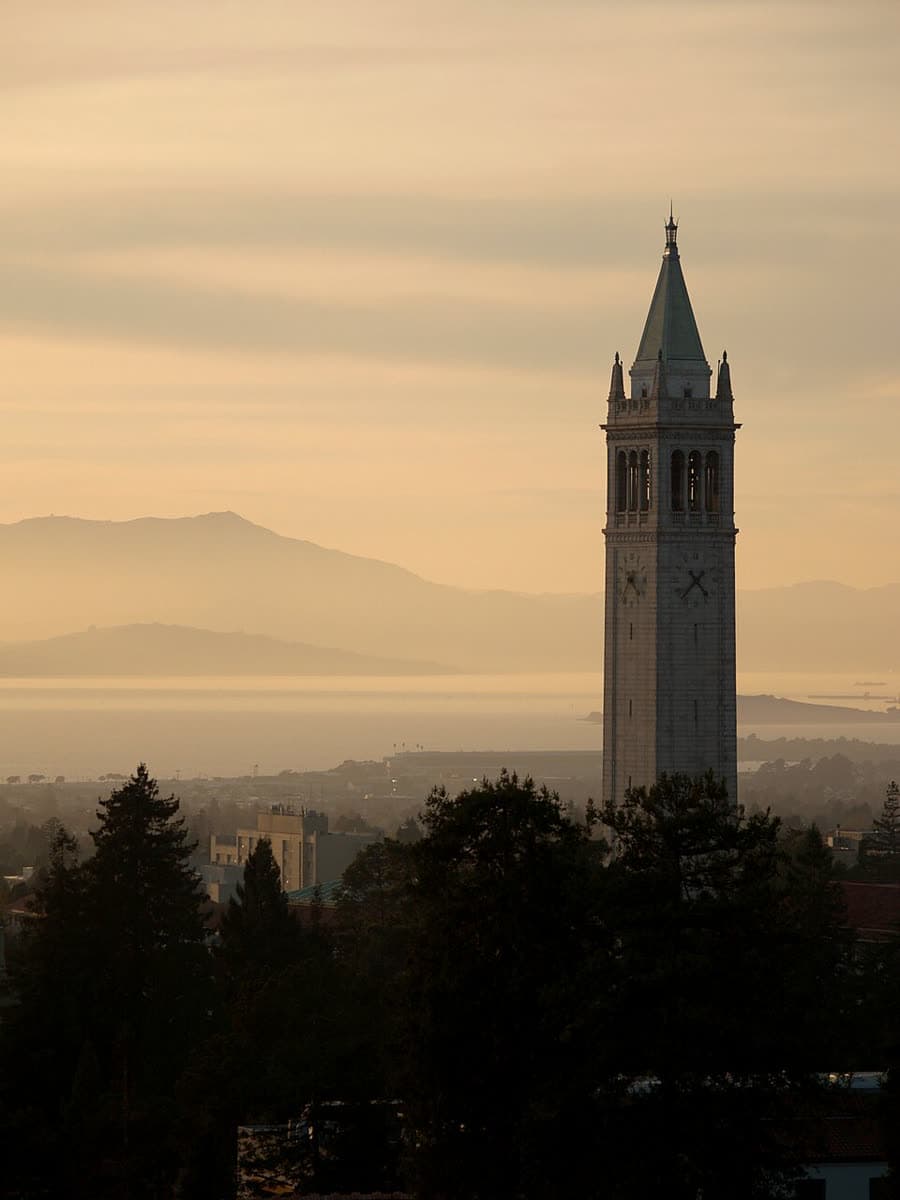
Outside campus, opinion is more divided. Berkeley's national survey found that most voters support research and regulated therapy, far fewer support decriminalization, and opinions split sharply along political lines.
What's next, part 1: the science and the politics
The next six months will settle a lot. Compass expects to file for FDA approval within weeks and is targeting a launch in the first half of 2027. Usona has reportedly filed already, MDMA is back under review after a resubmission, and Definium plans to file for its LSD drug in 2027. Even after an approval, the DEA has to move the drug out of Schedule I before anyone can prescribe it.
Politically, psychedelics have become one of the rare bipartisan issues. Texas's Republican governor signed $50 million for ibogaine research; the Trump administration's executive order fast-tracks reviews; the VA is funding its first psychedelic studies since the 1960s. But promises have outrun results. RFK Jr.'s "within 12 months" passed without an approval, and Massachusetts voters rejected legalization in 2024.
What's next, part 2: follow the money
The puzzle for investors is how to make money from a molecule that anyone can grow. Nobody can patent psilocybin itself, so Compass patented a specific crystal form of it and its use in treatment-resistant depression. Those patents survived challenges, but the claims are narrow. The bigger prize is the five years of FDA exclusivity that the first approved psilocybin drug should get, during which generics can't rely on its data. That exclusivity doesn't block a competitor that ran its own trials, and Usona, a nonprofit that refused to patent psilocybin and gives it free to researchers, has done exactly that. So the Compass–Usona race is really a race for that five-year window.
The longest-lasting advantage may not be the pill at all. Each dose requires a supervised session of six to eight hours at a certified site, and Compass says more than 8,500 treatment centers are already set up for that kind of session. Whoever owns the clinics, the training and the insurance relationships may own the market after the patents fade.
Compass's stock shows how investors are riding every twist. It went public at $17 in September 2020, peaked near $58 that December, and then slid for four years, falling below $3 in 2025 around the time its first phase 3 result disappointed. It climbed back to about $15 this year, then fell 28% in a single day this month on the report that Usona filed first. Big pharma is buying anyway, with AbbVie paying up to $1.2 billion for a psychedelic drug candidate in 2025 and Eli Lilly agreeing this summer to buy AtaiBeckley for up to $3.8 billion.
So, is the hype real?
Some of it is, and the strongest part is the biology. Psychedelics act on a well-understood receptor, measurably loosen the brain's networks and grow new connections between neurons. The clinical benefit is real too, but it's roughly the size of treatments we already have and well short of the miracle that early trials suggested. Nobody has solved the blinding problem in the trials yet, and some of the most exciting animal findings just failed to replicate.
In my view the timeline and the certainty are overhyped. What's underrated is how much good science is now happening, much of it in labs a few miles from where I live. The real test comes in 2027, when the FDA decides whether a mushroom compound becomes a medicine.
Sources
- Lu et al., Nature Neuroscience, Nov 2026 (five-lab replication); preprint: bioRxiv (opens in a new tab)
- Siegel et al. 2024, Nature (opens in a new tab): psilocybin desynchronizes brain networks
- Shao et al. 2021, Neuron (opens in a new tab): psilocybin grows dendritic spines
- Nardou et al. 2023, Nature (opens in a new tab): critical-period reopening
- Moliner et al. 2023, Nature Neuroscience (opens in a new tab): psychedelics bind TrkB
- Vollenweider & Preller 2020, Nature Reviews Neuroscience (opens in a new tab): review
- Goodwin et al. 2022, NEJM (opens in a new tab); Compass COMP005 and COMP006 results; Compass Q3 2026 filing (opens in a new tab)
- Raison et al. 2023, JAMA (opens in a new tab) (Usona); Psychedelic Alpha on Usona's filing (opens in a new tab)
- Bogenschutz et al. 2022, JAMA Psychiatry (opens in a new tab) (alcohol); Mitchell et al. 2023, Nature Medicine (opens in a new tab) (MDMA)
- UCSF on the 2026 JAMA Psychiatry blinding analysis (opens in a new tab)
- Carbonaro et al. 2016 (opens in a new tab) (challenging trips); RAND 2025 microdosing survey (opens in a new tab); Nutt et al. 2010, The Lancet (opens in a new tab)
- Gukasyan et al. 2022, Journal of Psychopharmacology (opens in a new tab) (Johns Hopkins 12-month follow-up); Davis et al. 2025, Journal of Psychedelic Studies (opens in a new tab) (five-year outcomes)
- Madden et al. 2025, Nature Communications (opens in a new tab) (5-HT1B and the claustrum); Daws et al. 2022, Nature Medicine (opens in a new tab) (brain networks after psilocybin therapy)
- Berkeley Psychedelics Survey 2023 (opens in a new tab); Berkeley Center for the Science of Psychedelics (opens in a new tab)
- Policy: STAT on Executive Order 14401 (opens in a new tab); Texas ibogaine program (opens in a new tab)
- psychedelics
- psilocybin
- neuroscience
- clinical trials
- biotech
- policy
Liked it? Pass it on.
Send it to someone, or get the next take the day it drops.